June’s Dual Promise: Juneteenth, Pride, and an Open Door at HelpLine
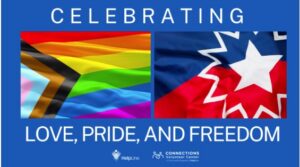
As June unfolds, it carries two profound anniversaries: Juneteenth and Pride Month. Both commemorate hard-won freedom. Both ask us to remember what was nearly erased. And both arrive this year in a climate that makes their meaning sharper, not softer. Federal diversity offices have been dismantled. Corporate Pride sponsorships have grown quiet. A specialized crisis line built specifically for LGBTQ+ young people was shut down, then left in uncertain limbo. None of that changes what these two months commemorate. If anything, it’s exactly why HelpLine exists: a place where every person, regardless of who they are or what they’re carrying, can find someone willing to listen.
Juneteenth: A Celebration of Freedom
Juneteenth, observed each year on June 19th, marks the day in 1865 when enslaved Texans finally learned of their freedom, two and a half years after the Emancipation Proclamation, and roughly two months after General Robert E. Lee’s surrender at Appomattox effectively ended the Civil War. Union Major General Gordon Granger arrived in Galveston, Texas, with federal troops and announced that the more than 250,000 enslaved Black people still held in the state were free. What began as a Texas-specific tradition has grown into a federal holiday, observed nationwide as both a day of remembrance and a reminder that freedom delayed is still freedom denied.
That federal status hasn’t been undone, and legally it can’t be, only Congress, not the executive branch, has the power to eliminate a federal holiday. But its symbolic weight has been tested. In 2026, Juneteenth was quietly dropped from the National Park Service’s list of fee-free days, alongside Martin Luther King Jr. Day, even as other dates were added elsewhere on the calendar. The holiday stands. The message behind that small omission is its own kind of commentary, and it’s one more reason the day’s true meaning shouldn’t be left to institutions to decide.
Pride Month: A Celebration of Identity and Rights
Pride Month commemorates the Stonewall Uprising of June 1969, a turning point in the LGBTQIA+ rights movement that grew, in large part, out of the resistance of Black and Latina trans women. It’s a month to honor how far the movement has come, to be honest about how far it still has to go, and to celebrate a community whose diversity is its strength.
This year, that celebration looks different in public than it did even a few years ago. A wave of corporate caution following political and consumer backlash has thinned out Pride sponsorships considerably. Some in the marketing industry have called 2026 a “gray area” year, companies are cautiously easing back in after a particularly quiet 2025, but nowhere near where visible support used to be. Smaller, grassroots, and community-funded Pride events have stepped into that gap. The parades may be a little less corporate. They are no less necessary.
Intersecting Struggles and Solidarity
The histories of Juneteenth and Pride Month are deeply intertwined. Bayard Rustin, a close advisor to Martin Luther King Jr. and an openly gay man, helped organize the 1963 March on Washington. The Stonewall uprising itself was led in part by Marsha P. Johnson, Sylvia Rivera, and Miss Major Griffin-Gracy — Black and Latina trans women who refused to disappear quietly. And Stonewall wasn’t the beginning. Years earlier, patrons fought back against police raids at Cooper Do-nuts in Los Angeles, the Black Cat Tavern, and Compton’s Cafeteria in San Francisco, where trans and nonbinary people resisted police violence and anti-trans harassment well before 1969. Figures like Lucy Hicks Anderson and Gladys Bentley carried that same resistance even earlier, simply by living openly as themselves in eras that demanded they not. None of this was separate from the fight for Black liberation. It was, and is, the same fight for the right to exist freely and without apology.
What’s Different in 2026
It would be dishonest to write this the way we wrote it two years ago, as though progress only moves in one direction. Since early 2025, a series of federal executive orders from the Trump administration has worked to eliminate DEI offices and positions across federal agencies, and a March 2026 order extended that pressure to federal contractors, threatening to cancel contracts for companies found to maintain DEI programs the administration deems unlawful. Major private employers have followed suit, scaling back diversity programs largely out of legal and political caution rather than any change in conviction. Meanwhile, state legislatures are considering nearly 800 bills this year alone that would negatively affect transgender and gender-nonconforming people, continuing what’s now a sixth consecutive record-breaking year for this kind of legislation.
The piece of this landscape that hits closest to home for an organization like ours involves crisis care itself. In 2025, the federal government shut down the 988 Suicide & Crisis Lifeline’s specialized “Press 3” service, a line that had connected more than a million LGBTQ+ young people with counselors trained specifically to support them since 2022. Advocates argued the decision was a political move layered on top of a suicide-prevention service, arriving during Pride Month, against a population already facing dramatically higher risk. There are now early signs the administration may restore some version of that service, though reportedly tied to compliance with a separate executive order restricting how gender identity can be addressed, leaving many who watched it disappear cautious about celebrating just yet.
We share all of this not to dampen the celebration, but because it’s the honest context this June is happening in. Solutions and policies can’t create equitable outcomes until the underlying systems of racism, transphobia, and exclusion they sit on top of are actually addressed.
Why HelpLine Holds the Door Open
This is exactly the moment HelpLine was built for. When specialized, identity-specific support gets defunded or politicized, the need for it doesn’t disappear, it just goes looking for somewhere else to land. We want to be that somewhere. Whoever you are, whatever you’re carrying, whether you’re celebrating this June or struggling through it or both at once, HelpLine’s door stays open. That’s not a slogan we adopted because it was trendy. It’s the actual job: making sure that no matter what gets stripped out of a federal calendar or a corporate sponsorship list, the people who need to be heard still have somewhere to turn.
June asks us to hold both joy and vigilance at the same time. That duality is the whole point. So, this month, we’re celebrating Juneteenth and Pride exactly as they deserve, loudly, honestly, and with HelpLine’s doors open to everyone who walks through them.
If you or someone you love needs to talk to someone, HelpLine is here at 1.800.684.2324, 211 or text helpline to 898211. Call or text 988 for the Suicide & Crisis Lifeline.